

What Is Beef Jerky? Meaning, How It's Made and What's Inside
So, what is beef jerky? It's beef cut into thin strips, marinated, then slowly dried until it turns firm, dense and deeply flavorful. Drying removes most of the water from the meat, which concentrates the taste and lets it keep without a fridge. That's the beef jerky meaning in a nutshell; the rest of this article walks through how it all works in practice.
Where do the word and the product come from?
The word "jerky" comes to English from a term in the Andean languages meaning dried meat. Drying meat is one of the oldest ways to preserve it, and cuisines all over the world developed their own versions. Jerky as we know it today, in marinated strips, became popular mostly in North America, and it has since made its way across the Atlantic.
You'll now find it in hiking packs, gym bags and office drawers, which is quite a career for a simple slice of beef.
How is beef jerky made?
The principle comes down to three steps: slice, marinate, dry. The meat is first cut into thin, even strips, because thickness determines the final texture. It's then marinated in a spice blend, which gives it its personality, and slowly dried at low temperature.
At Tof Jerky, we work with Belgian Holstein beef from responsible farming, using top sirloin (known in Belgium as "aiguillette de baronne") and beef tenderloin. Cutting, marinating and drying are done with machines. The spice blends, the oven loading and the packaging are done by hand, in batches, by a small team, in our workshop in Anderlecht, Brussels.
Drying takes its time: 1,005 minutes for the Classic and the Spicy, 1,030 minutes for the Teriyaki and the Barbecue, or just under seventeen hours. Once dried, the meat has lost a lot of its weight. Our yield is 40%, so 100 g of fresh beef gives 40 g of jerky. To make 1 kg of jerky, you need 2.5 kg of fresh meat. It's also why jerky is more a precision product than a volume product.
What does beef jerky taste like, and what's in it?
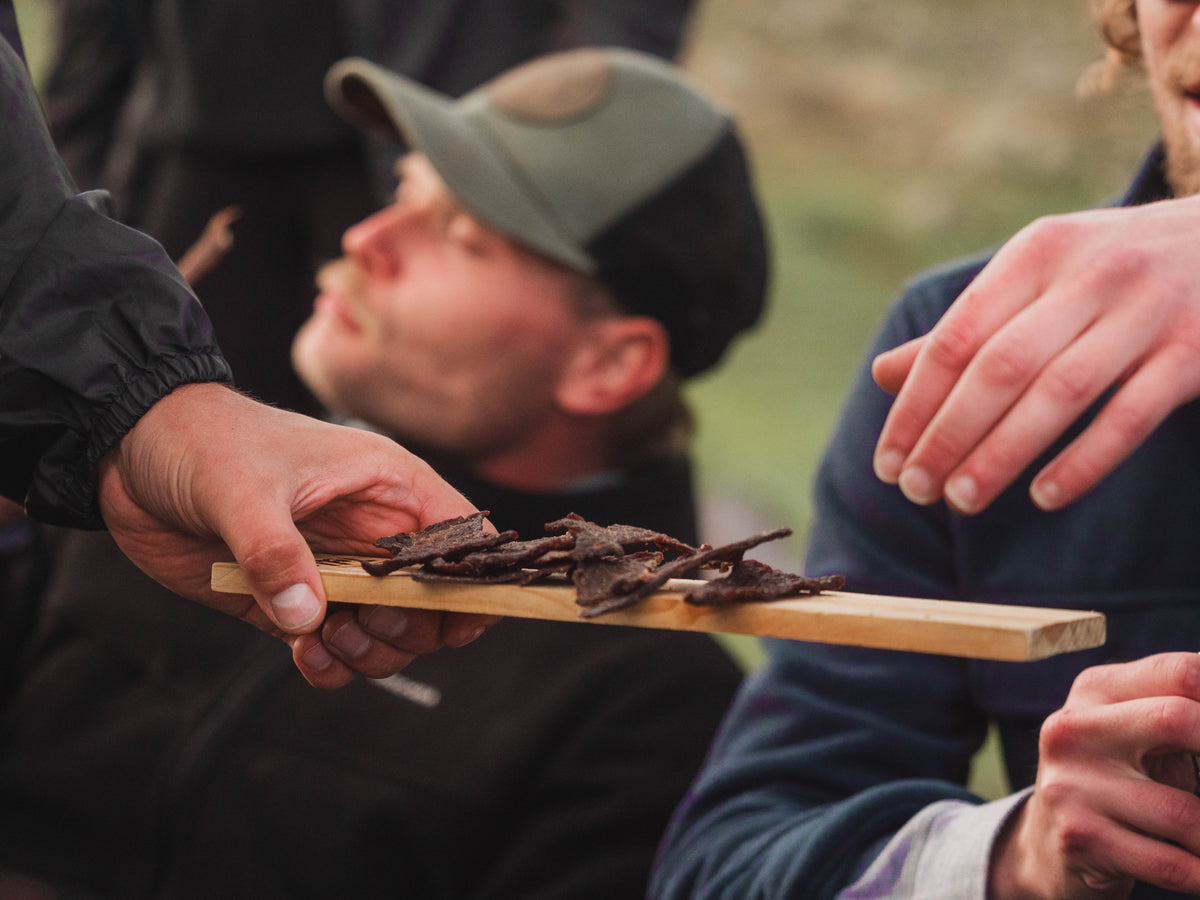
The taste is intense beef, lifted by the marinade. The texture is firm and satisfying to chew, without being tough when the drying is done right. It tears into fibers rather than cutting cleanly, and that's exactly its charm. Expect a little while of chewing: that's the price of a snack that lasts, and nobody ever complained about enjoying a good thing for longer.
As for what's inside, our jerkies pack 50 g of protein per 100 g. They're low in fat, gluten-free, and contain no nitrites and no additives. We add a little brown sugar to balance the flavors, but never sweeteners or glucose syrup.
Our idea is simple: an artisanal product designed to be good and wholesome, and easy to carry wherever you go. Recipes for jerky vary widely from one maker to another, so if you ever want to know what's in a bag, the ingredient list on the packaging is always the place to look.
How do you eat it and store it?
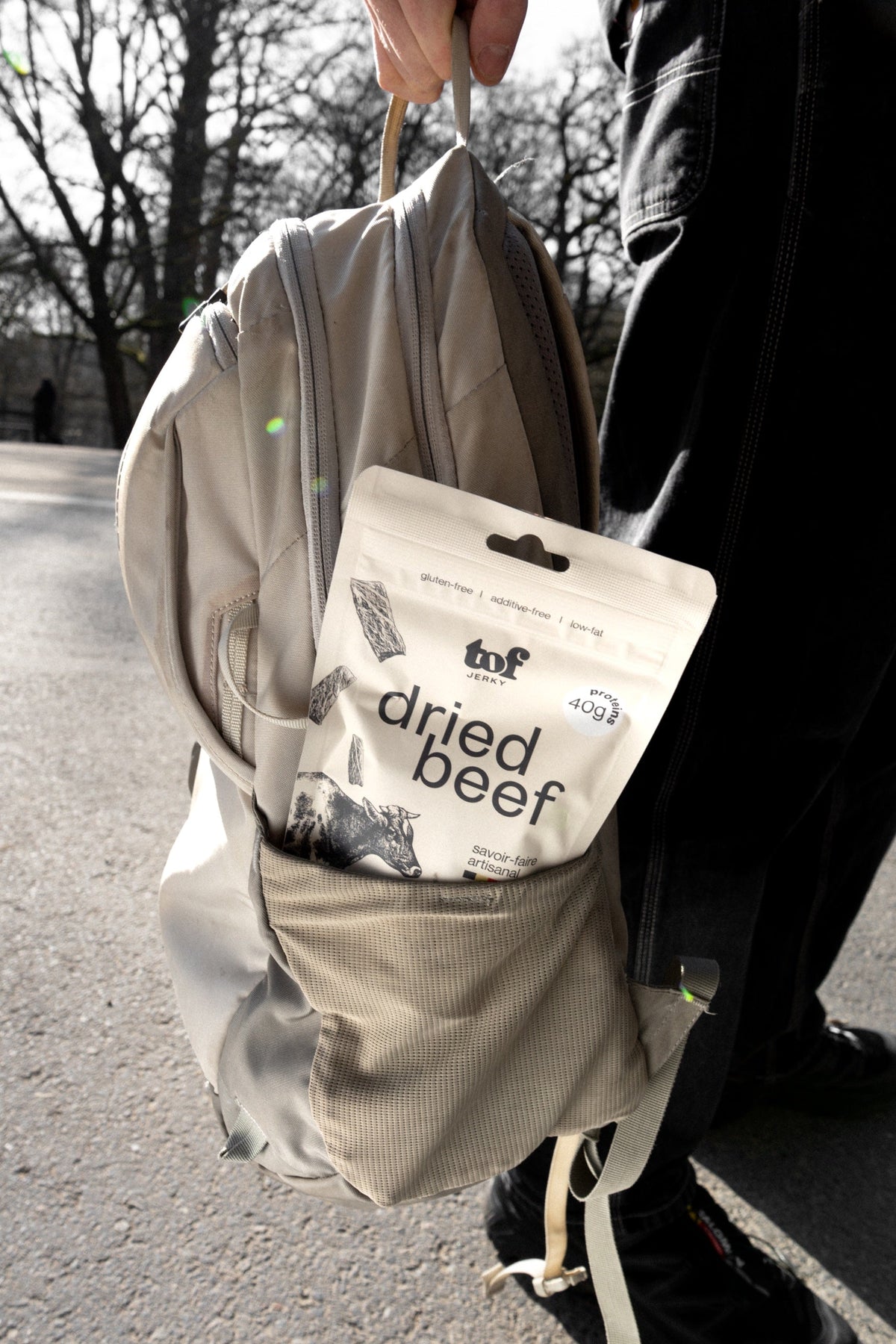
Beef jerky is eaten as is, straight from the bag, and that's probably its best quality. Slip it in a pocket before a bike ride, in a hiking pack, on a desk or on a snack board. Some people chop it into small pieces to liven up a salad or an omelet, but it doesn't need any of that to be good.
Storage is simple. Unopened, our jerky keeps for 8 to 10 months at room temperature, no fridge needed. Once the bag is open, it's best to finish it within a week. The 35 g bags are made for a grab-and-go portion, the 80 g ones for sharing or for bigger appetites.
Beef jerky, biltong, Bündnerfleisch: what's the difference?
These products have one thing in common, dried meat, but they don't tell the same story. Beef jerky usually comes in thin strips, marinated then dried at low temperature. Its flavor depends a lot on the marinade, which explains the wide variety of tastes out there.
Biltong comes from Southern Africa. It's most often made from thicker strips of meat, seasoned with spices and air-dried, then sliced when you're ready to eat. The texture and taste differ from jerky's, and you'll often find spices like coriander in it.
Bündnerfleisch (known in French as "viande des Grisons"), finally, is salted, dried beef, eaten in very thin slices, much like a cured meat. Each product has its fans and its occasions, and nothing stops you from loving all three.
So, what is Tof Jerky?
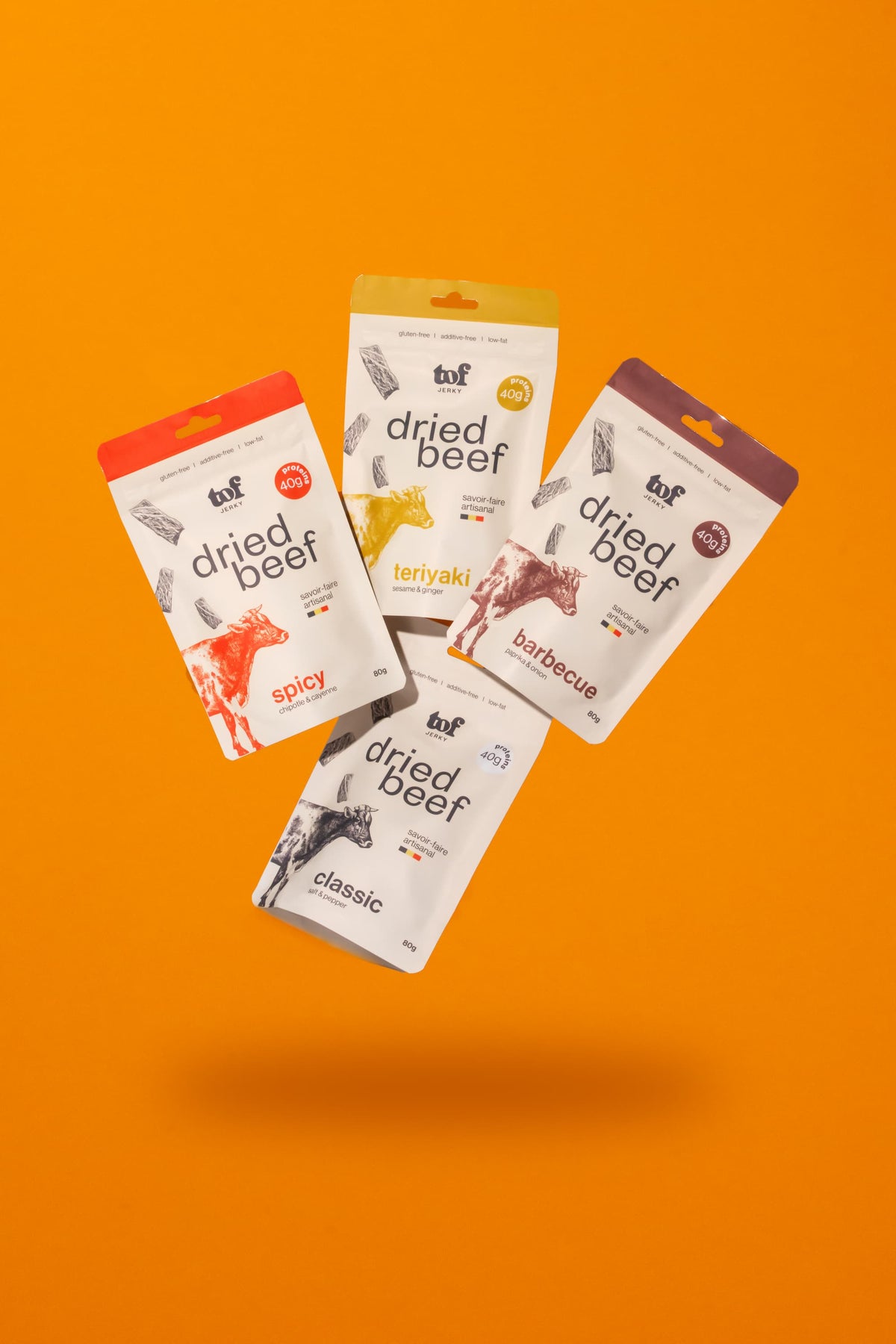
Tof Jerky is a Belgian brand of craft beef jerky, made in our workshop in Anderlecht from 100% Belgian Holstein beef. We offer four flavors.
- Classic, salt and pepper;
- Barbecue, paprika and onion;
- Teriyaki, sesame and ginger;
- Spicy, chipotle and cayenne.
The bags come in 35 g and 80 g sizes, in packs of 5 or 10. If you can't decide, the simplest move is to try all four. The Discovery Pack brings together every flavor, at €18.96 for 140 g in 35 g bags, or €13.54 per 100 g, or at €37.96 for 320 g in 80 g bags, or €11.86 per 100 g. Delivery is free on orders of €50 or more.
To get acquainted, discover the Discovery Pack and pick your favorite flavor.
Frequently asked questions
Does beef jerky need to be refrigerated?
No. As long as the bag is sealed, it keeps for 8 to 10 months at room temperature. Once opened, it's best to finish it within a week.
Does beef jerky contain gluten or nitrites?
Our jerkies are gluten-free, nitrite-free and additive-free. For any other product, always check the ingredient list on the packaging.
How much protein is in beef jerky?
At Tof Jerky, there are 50 g of protein per 100 g.
Which flavor should I start with?
The Classic, with its salt and pepper, is the easiest way to discover the product. If you like bolder flavors, the Spicy or the Teriyaki are good starting points, and the Discovery Pack lets you taste everything.

Leave a comment
This site is protected by hCaptcha and the hCaptcha Privacy Policy and Terms of Service apply.